
RaNNC (Rapid Neural Network Connector), automatic parallelization middleware for deep learning developed jointly by Data-driven Intelligent System Research Center (DIRECT), the National Institute of Information and Communications Technology (NICT, President: TOKUDA Hideyuki, Ph.D.), and the University of Tokyo (President: FUJII Teruo), won first place at the PyTorch Annual Hackathon 2021 (PyTorch Developer Tools & Libraries category).
December 8, 2021
December
-
-
Clarivate Analytics unveiled a list of "Highly Cited Researchers 2021" in London on November 16, 2021, and one researcher was selected from NICT.December 2, 2021
November
-
Date : [Tue], December 7, 2021 [Thu], December 9, 2021 Place : https://quantum-innovation.riken.jp/
We kindly ask you to register beforehand. Registration is free of charge.Quantum Innovation 2021 (The International Symposium on Quantum Science, Technology and Innovation) will be held as a virtual conference from Tuesday, December 7th, through Thursday, December 9th.November 30, 2021
The aim of this symposium is to introduce quantum information processing technology and its trends in practical applications through guest speeches and technical sessions of each field. We expect to share a common view on the current study status including implementation results both in Japan and abroad as well as to promote international collaborations through the meetings with key persons from each country. We look forward to your participation. -
NICT proudly announces that Professor Dr. Andreas Dengel*, Executive Director of German Research Center for Artificial Intelligence (DFKI), awarded "the Order of the Rising Sun, Gold Rays with Neck Ribbon" of Japan in the autumn of 2021.November 25, 2021
-
A study group consisting of the University of Electro-Communications (UEC), National Institute of Information and Communications Technology (NICT), Meiji University, National Institute of Polar Research (NIPR), and Kyushu University has devised a method to observe noctilucent clouds (NLCs) appearing at 80-85 km altitude by focusing on the rim of the Earth captured in the disk images from the geostationary meteorological satellite Himawari 8. The group has established a real-time NLCs monitoring system using the satellite data. With the new monitoring method of NLCs or “Climate Canary”, contributions to studies related to climate changes including global warming are expected.November 11, 2021
October
-
NICT's research paper on nitride superconducting qubit, published on Monday, September 20, 2021, was selected as a featured image highlight at <i>Communications Materials</i> (an open-access journal from Nature Research), so an optical micrograph image of a nitride superconducting qubit circuit is displayed as the main screen view of the journal.October 29, 2021
-
Toshiba Corporation, Tohoku University Tohoku Medical Megabank Organization (ToMMo), Tohoku University Hospital, and the National Institute of Information and Communications Technology (NICT) have developed a distributed storage technology that combines quantum cryptography communication and secret sharing technologies, successfully demonstrating the world’s first experimental large-scale genome analysis data backup to multiple sites. These technologies will allow data backup that prevents data leaks and tampering over long periods and are expected to contribute to safe data management in the fields of genomic research and medicine.October 7, 2021
September
-
Researchers at the National Institute of Information and Communications Technology (NICT, President: TOKUDA Hideyuki, Ph.D.), in collaboration with researchers at the National Institute of Advanced Industrial Science and Technology (AIST, President: Dr. ISHIMURA Kazuhiko) and the Tokai National Higher Education and Research System Nagoya University (President: Dr. MATSUO Seiichi) have succeeded in developing an all-nitride superconducting qubit using epitaxial growth on a silicon substrate that does not use aluminum as the conductive material. This qubit uses niobium nitride (NbN) with a superconducting transition temperature of 16 K (-257 °C) as the electrode material, and aluminum nitride (AlN) for the insulating layer of the Josephson junction. It is a new type of qubit made of all-nitride materials grown epitaxially on a silicon substrate and free of any amorphous oxides, which are a major noise source. By realizing this new material qubit on a silicon substrate, long coherence times have been obtained: an energy relaxation time (T1) of 16 microseconds and a phase relaxation time (T2) of 22 microseconds as the mean values. This is about 32 times T1 and about 44 times T2 of nitride superconducting qubits grown on a conventional magnesium oxide substrate.September 20, 2021
August
July
-
The National Institute of Information and Communications Technology (NICT, President: TOKUDA Hideyuki, Ph.D.) has developed a broadband and high-precision terahertz (THz) frequency counter based on a semiconductor-superlattice harmonic mixer. It showed a measurement uncertainty of less than 1 x 10-16 from 0.12 THz to 2.8 THz. This compact and easy-to-handle THz counter operating at room temperature suits for various THz applications supported by the next-generation ICT infrastructure, “Beyond 5G / 6G”.July 29, 2021
-
Researchers from the National Institute of Information and Communications Technology (NICT, President: TOKUDA Hideyuki, Ph.D.), Network Research Institute, succeeded the first S, C and L-bands transmission over long-haul distances in a 4-core optical fiber with standard outer diameter (0.125 mm). The researchers, lead by Benjamin J. Puttnam, constructed a transmission system that makes full use of wavelength division multiplexing technology by combining different amplifier technologies, to achieve a transmission demonstration with date-rate of 319 terabits per second, over a distance of 3,001 km. Using a common comparison metric of optical fiber transmission the data-rate and distance produce of 957 petabits per second x km, is a world record for optical fibers with standard outer diameter.July 12, 2021
June
-
NICT, along with ten other global leading-edge research and education networks in North America, East Asia, Southeast Asia, and Oceania, signed a memorandum of understanding to join the Asia Pacific Oceania network (APOnet) and collaboratively improve high-speed network services in the Asia Pacific Oceania region.June 17, 2021
-
Date : [Fri], July 9, 2021The Association of Radio Industries and Businesses (ARIB) and the National Institute of Information and Communications Technology (NICT) will co-organize the Symposium on the Development of Frequency Resources 2021, under the theme of “Looking into the future ICT through Local (Rural) 5G and Beyond 5G / 6G” on July 9 at Meiji Kinenkan and on Zoom webinar.June 14, 2021
May
-
[Highlights]May 21, 2021
・Integrated cyber attack analysis platform "NIRVANA Kai" newly supports IPv6 and enhances its functions.
・Observation of IPv6 communications, collection of IPv6-related alerts, and real-time visualization of IPv6 networks
・Expected to simplify security operations in IPv6 networks. -
Our dynamically changing lifestyle can make it hard for many to stay motivated on work and study, which calls for new intervention strategies. In a recent study published in BMC Psychology, researchers explore how nurturing feelings of gratitude can enhance motivation among college students. Their results show that a keeping a daily gratitude journal for only two weeks has a positive impact on academic motivations that can last months.May 13, 2021
April
-
The National Institute of Information and Communications Technology (NICT, President: TOKUDA Hideyuki, Ph.D.) has released white papers on “Beyond 5G/6G” and “Quantum Network” to accelerate R&D collaboration with other research institutions. The white papers summarize the social vision and use cases that are expected to be realized through the progress of Beyond 5G/6G and quantum network technologies, as well as the key technologies and R&D roadmap necessary to realize them.April 30, 2021
March
-
The National Institute of Information and Communications Technology (NICT, President: TOKUDA Hideyuki, Ph.D.) has conducted an international joint experiment with the German Aerospace Center (DLR) between the optical terminal (OSIRISv1) onboard the University of Stuttgart’s Flying Laptop satellite and NICT's optical ground station equipped with newly developed optical bench with fine-pointing system. In February 2021, success in receiving the downlink light from OSIRISv1 at NICT's optical ground station was achieved.March 25, 2021
-
The National Institute of Information and Communications Technology (NICT, President: TOKUDA Hideyuki, Ph.D.), in collaboration with Electronic Navigation Research Institute, National Institute of Maritime, Port and Aviation Technology (ENRI, Director General: FUKUDA Yutaka) and Chiba University (President: TOKUHISA Takeshi), has started the service of shortwave propagation simulator (HF-START). It provides real-time shortwave propagation that reflects real space weather information from ground-based observations and model calculations. The HF-START web system has been successfully developed and is now available at https://hfstart.nict.go.jp/.March 24, 2021
-
The Japan Aerospace Exploration Agency (JAXA) and the National Institute of Information and Communications Technology (NICT) confirmed that a bidirectional optical link was established between the laser-communication terminal for inter-satellite optical communications (Laser Utilizing Communication System: LUCAS*) aboard the Optical Data Relay Satellite (Fig. 1), which was launched by the H-IIA F-43 rocket from the Tanegashima Space Center on November 29th, 2020, and the optical ground station at the Okinawa Electromagnetic Technology Center of NICT (Fig. 2).March 18, 2021
February
-
The National Institute of Information and Communications Technology (NICT, President: TOKUDA Hideyuki, Ph.D.) and Toyota Motor Corporation (TOYOTA) have succeeded in experimenting with stabilization technology for manufacturing systems using wireless communication, and to have realized a "non-stop line”. The "non-stop line" can be realized to detect the introduction of unregistered terminals by visualizing the radio, to suppress unplanned radio congestion, and avoiding sudden interference that occurs by coordinated control of different systems. This time, we have demonstrated these technologies at two operating TOYOTA plants.February 18, 2021
January
-
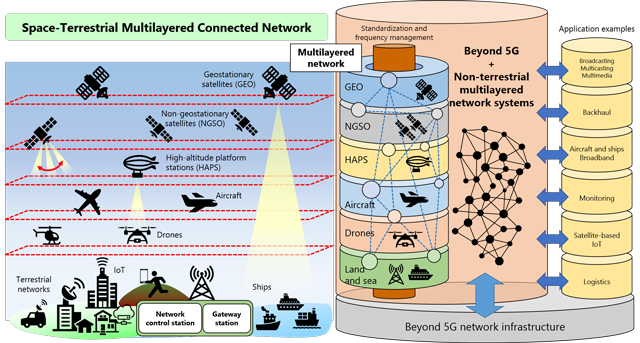
NICT released a report summarizing what was discussed in the "Study Group on the Integration of Satellite Communications and 5G/Beyond 5G" (August 2019 - February 2020) to study the effective use of integration of satellite communications and 5G/Beyond 5G, with the participation of domestic terrestrial communications providers, satellite communications providers, satellite-related manufacturers, potential users, universities, research institutes, and standardization bodies.Janualy 29, 2021
-
We released a new periodical "NICT REPORT 2021” (ebook/PDF).Janualy 4, 2021