




Fujitsu, Nagoya University, JAMSTEC and NICT develop technology to automatically optimize parameters for solar energetic particle simulations
Background
Future Plans
Trademark information
Related Links
- Automated Optimization of Solar Energetic Particle Acceleration and Transport Parameters Against Five-Spacecraft Observations of the 9 October 2021 Event:
https://doi.org/10.1038/s41598-026-70869-9 - Human-Interpretable SEP Event Prediction Using White-Box Explainable AI:
https://doi.org/10.1029/2025SW004635 - Fujitsu and Tokai National Higher Education and Research System develop space weather prediction capabilities technology leveraging AI:
https://global.fujitsu/en-global/pr/news/2026/01/28-01 - Fujitsu and Tokai National Higher Education and Research System collaborate on AI-based space weather research:
https://info.archives.global.fujitsu/global/about/resources/news/press-releases/2024/0314-01.html - Nagoya University Institute for Space-Earth Environmental Research:
https://www.isee.nagoya-u.ac.jp/en/ - JAMSTEC:
https://www.jamstec.go.jp/e/ - NICT:
https://www.nict.go.jp/en/ - JAXA:
https://global.jaxa.jp/ - LIP:
https://www.lip.pt/?lang=en& - University of Lisbon:
https://www.ulisboa.pt/en/
About Fujitsu
About Nagoya University, Tokai National Higher Education and Research System
About Japan Agency for Marine-Earth Science and Technology
About National Institute of Information and Communications Technology
Notes
Fujitsu Limited Head office: Kawasaki, Kanagawa, Japan. Representative Director and CEO: Takahito Tokita. Back to contents
Nagoya University, Tokai National Higher Education and Research System Location: Nagoya, Aichi, Japan. President: Naoshi Sugiyama. The research was conducted with the university’s Institute for Space-Earth Environmental Research (ISEE). Back to contents
Japan Agency for Marine-Earth Science and Technology Location: Yokosuka, Kanagawa, Japan. President: Tomohiko Kawamura. Back to contents
National Institute of Information and Communications Technology Location: Koganei, Tokyo, Japan. President: Hideo Ohno. Back to contents
Research participants In addition to Fujitsu, Nagoya University’s ISEE, JAMSTEC and NICT, the research involved the Japan Aerospace Exploration Agency (JAXA), the Laboratory of Instrumentation and Experimental Particle Physics (LIP) and the University of Lisbon, both in Portugal. Back to contents
Basis for the “world’s first” claim (according to Fujitsu research, as of October 2026)
The novelty of this technology lies in its simultaneous fulfillment of the following three conditions
(1) It uses simultaneous observations from multiple spacecraft as constraints, enabling the identification of parameters that vary by direction.
(2) It couples an MHD simulation with a particle acceleration and transport model, enabling the strength and shape of shocks generated by coronal mass ejections (CMEs) to be reflected in particle acceleration calculations.
(3) It automatically determines parameters related to particle acceleration and transport through black-box optimization, without manual intervention during the search.
Back to contents
Solar energetic particles (SEPs)
High-energy protons and electrons accelerated by solar flares and CMEs and released into interplanetary space.
This research focused on protons.
Back to contents
Paper information Hiroyuki Tako Ishikawa et al., “Automated Optimization of Solar Energetic Particle Acceleration and Transport Parameters Against Five-Spacecraft Observations of the 9 October 2021 Event,” Scientific Reports (2026). DOI: 10.1038/s41598-026-70869-9. Published October 20, 2026. Back to contents
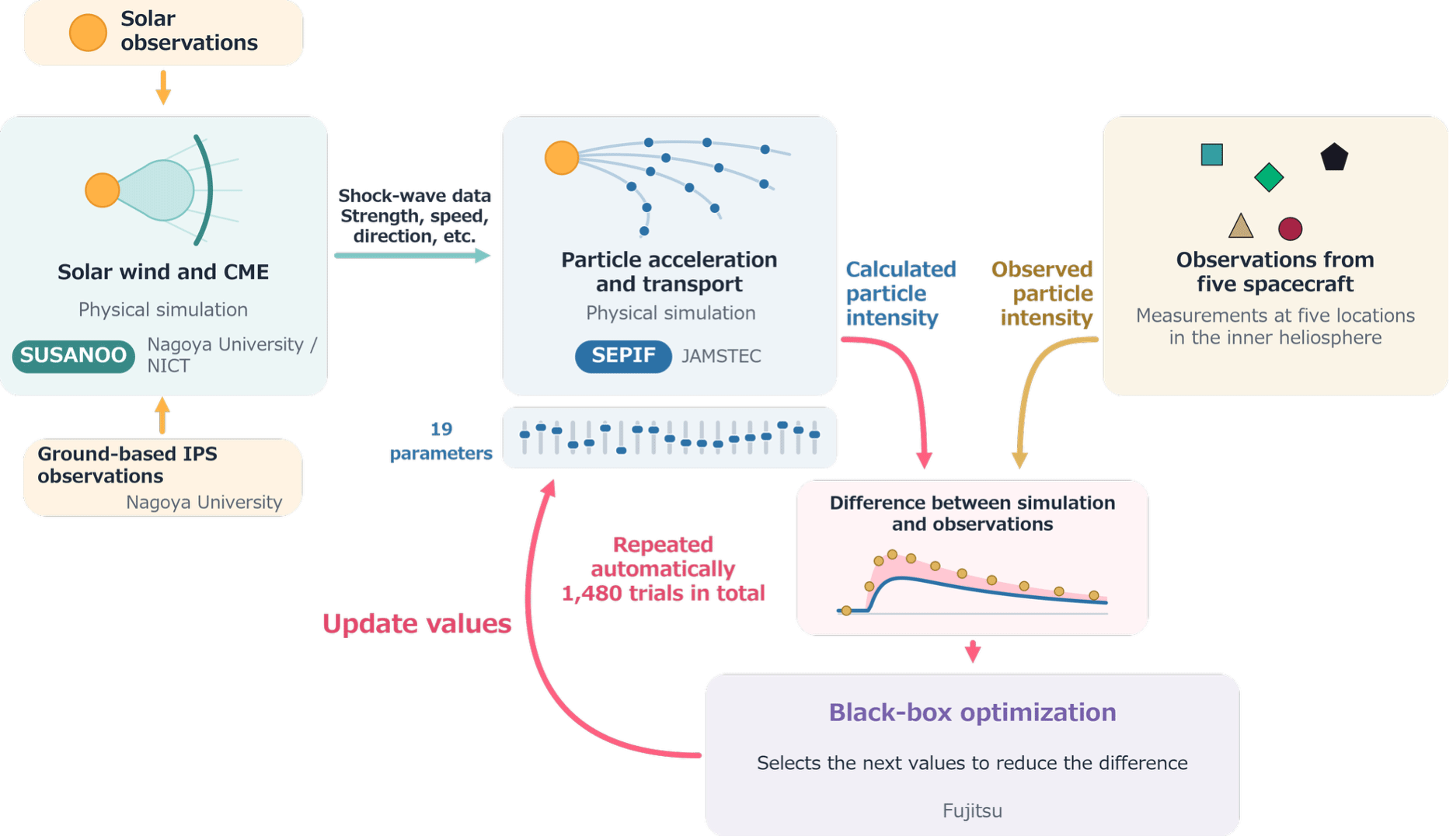
Black-box optimization A method that searches for good solutions through repeated trials and evaluations without assuming the internal structure of the objective function. This technology combines broad exploration using a quasi-Monte Carlo method (Sobol’ sequence) with focused exploration using TPE (Tree-structured Parzen Estimator), a form of Bayesian optimization. The open-source optimization framework Optuna was used for implementation. Back to contents
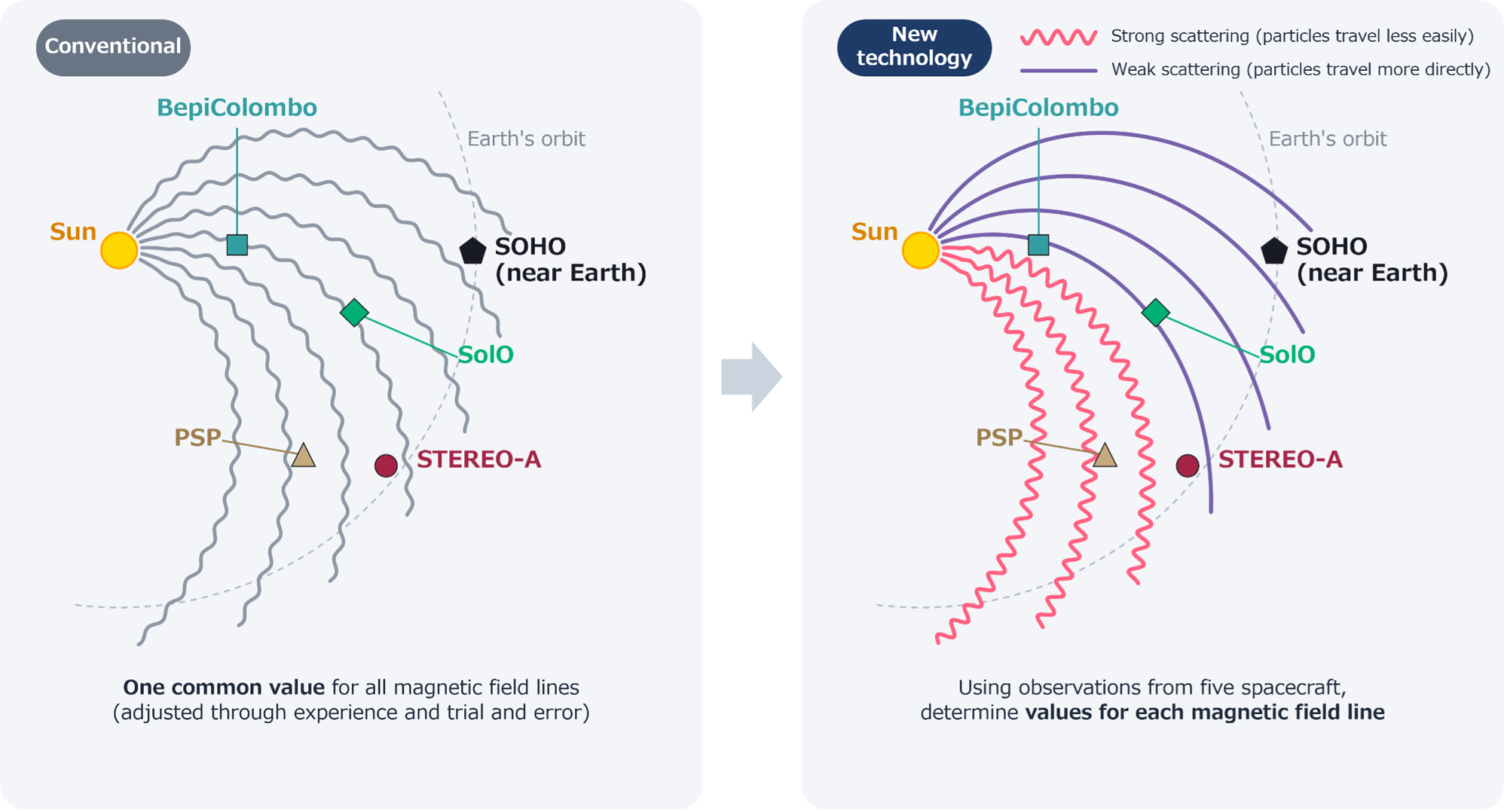
Automatic setting of 19 parameters The 19 parameters comprise seven mean free path values, one for each magnetic field line, representing scattering strength, and 12 injection efficiency values, one for each direction, representing the fraction of particles that enter the acceleration process at a shock wave. Because each trial requires a complete, time-consuming simulation, the number of trials is limited. The two-stage search described in Note 9 narrowed the candidates through 1,000 broad trials and 480 focused trials in promising regions, for a total of 1,480 trials. Applied to an SEP event that occurred on October 9, 2021 and was simultaneously observed by five spacecraft, the method broadly reproduced the onset, rise and peak of the particle intensity at all five spacecraft. The procedure and evaluation criteria were defined in advance, and independent repetitions confirmed the same overall trend. Back to contents
Fujitsu Solar Energetic particle Intelligent Tuning and Evaluation Network (SEITEN) The name SEITEN is derived from the Japanese word seiten, meaning “clear sky.” It reflects two aspirations: to clear up the behavior of SEPs, and to help secure the all-clear, the state in which they pose no threat. Back to contents
SUSANOO An acronym for Space-weather-forecast-Usable System Anchored by Numerical Operations and Observations. Developed by Nagoya University’s ISEE, SUSANOO is an MHD simulation that calculates the propagation of solar wind and CMEs through interplanetary space. NICT operates the system and uses it for daily arrival predictions of solar-wind disturbances in space weather forecasting. Interplanetary scintillation (IPS) is the twinkling of radio waves from distant radio sources, caused by irregularities in the density of the solar wind that scatter the waves. The twinkling becomes stronger when a CME crosses the path of the radio waves. In this research, multiple SUSANOO-CME simulations were conducted with varying CME magnetic flux. IPS observables synthesized from the simulation results were compared with actual IPS observations made by Nagoya University’s ISEE. The case most consistent with IPS observations and another case most consistent with the CME arrival time at Earth were used for SEP acceleration and transport calculations. Back to contents
MHD simulation A computational method that treats plasma as a fluid and computes its behavior including interactions with magnetic fields. Back to contents
SEPIF An acronym for Solar Energetic Particle Injection and Focused transport model. Developed by JAMSTEC, SEPIF calculates particle acceleration at shock waves and transport along magnetic field lines. Back to contents
Estimation of the spatial distribution of parameters and the five spacecraft Because the shape and strength of a shock wave differ by direction as viewed from the Sun, the strength of particle scattering is also expected to vary by direction. A single observation point cannot distinguish these differences, so parameters previously had to be assumed spatially uniform. The new technology searched for solutions that simultaneously satisfied observations from five spacecraft located 0.33 to 1.0 astronomical units from the Sun (1 astronomical unit, the average Earth-Sun distance, is about 150 million km) and spread across approximately 50 degrees as viewed from the Sun, allowing directional parameter distributions to be estimated. The researchers also confirmed that assuming a uniform mean free path regardless of direction increased error and prevented the simultaneous reproduction of observations from all five spacecraft. The five spacecraft, each equipped with energetic particle instruments, are BepiColombo (a joint ESA-JAXA mission to Mercury), Solar Orbiter (a joint ESA-NASA mission), Parker Solar Probe (a NASA mission), STEREO-A (a NASA mission) and SOHO (a joint ESA-NASA mission). Back to contents
Coronal mass ejection (CME) A large-scale eruption of plasma from the solar atmosphere. A fast CME can drive a shock wave at its leading edge that accelerates particles. Back to contents
Contact information for this matter
Fujitsu Limited
Inquiry form: Fujitsu
Nagoya University, Tokai National Higher Education and Research System
Public Relations Division, General Affairs Department
Tel: +81-52-558-9735
 t.mail.nagoya-u.ac.jp
Japan Agency for Marine-Earth Science and Technology
Press Office, Business Promotion Department, Planning Division
Tel: +81-45-778-5690
jamstec.go.jpNational Institute of Information and Communications Technology
Press Office, Public Relations Department
nict.go.jp